Monthly Archives: November 2016
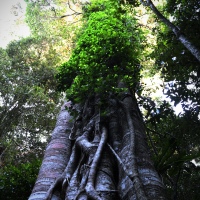
Aerial Root Of The Plant
iPhoneOgraphy – 10 Nov 2016 (Day 315/366)
In vascular plants, the root is the organ of a plant that typically lies below the surface of the soil. Roots can also be aerial or aerating, that is growing up above the ground or especially above water. Furthermore, a stem normally occurring below ground is not exceptional either (see rhizome). Therefore, the root is best defined as the non-leaf, non-nodes bearing parts of the plant’s body. However, important internal structural differences between stems and roots exist.
Aerial roots are roots above the ground. They are almost always adventitious. They are found in diverse plant species, including epiphytes such as orchids, tropical coastal swamp trees such as mangroves, the resourceful banyan trees, the warm-temperate rainforest rātā (Metrosideris robusta) and pōhutukawa (M. excelsa) trees of New Zealand and vines such as Common Ivy (Hedera helix) and poison ivy (Toxicodendron radicans).
Aerial roots may receive water and nutrient intake from the air. There are many types of aerial roots, some such as mangrove aerial roots, are used for aeration and not for water absorption. In other cases they are used mainly for structure, and in order to reach the surface. Many plants rely on the leaf system for gathering the water into pockets, or onto scales. These roots function as terrestrial roots do.
Most aerial roots directly absorb the moisture from fog or humid air.
Some surprising results in studies on aerial roots of Orchids show that the ‘Velamen’ – the white spongy envelop of the aerial roots, are actually totally water proof, preventing water loss but not allowing any water in. Once reaching and touching a surface the Velamen is not produced in the contact area, allowing the root to absorb water like terrestrial roots.
Many other Epiphytes – non-parasitic or semi-parasitic plants living on the surface of other plants, have developed cups and scales that gather rainwater or dew. The aerial roots in this case work as regular surface roots. There are also several types of roots creating a cushion where a high humidity is retained.
Some of the aerial roots, especially in the Tillandsia genus, have a physiology that collects water from humidity, and absorbs it directly.
The fossil record of roots – or rather, infilled voids where roots rotted after death – spans back to the late Silurian. Their identification is difficult, because casts and molds of roots are so similar in appearance to animal burrows. They can be discriminated using a range of features.
Shot & Edited using iPhone 6+
Share this:

Going Up Or Down?
iPhoneOgraphy – 09 Nov 2016 (Day 314/366)
An elevator (US and Canada) or lift (UK, Australia, Ireland, New Zealand, and South Africa) is a type of vertical transportation that moves people or goods between floors (levels, decks) of a building, vessel, or other structure. Elevators are generally powered by electric motors that either drive traction cables or counterweight systems like a hoist, or pump hydraulic fluid to raise a cylindrical piston like a jack.
In agriculture and manufacturing, an elevator is any type of conveyor device used to lift materials in a continuous stream into bins or silos. Several types exist, such as the chain and bucket bucket elevator, grain auger screw conveyor using the principle of Archimedes’ screw, or the chain and paddles or forks of hay elevators.
The earliest known reference to an elevator is in the works of the Roman architect Vitruvius, who reported that Archimedes (c. 287 BC – c. 212 BC) built his first elevator probably in 236 BC. Some sources from later historical periods mention elevators as cabs on a hemp rope powered by hand or by animals.
In 1000, the Book of Secrets by al-Muradi in Islamic Spain described the use of an elevator-like lifting device, in order to raise a large battering ram to destroy a fortress. In the 17th century the prototypes of elevators were located in the palace buildings of England and France. Louis XV of France had a so-called ‘flying chair’ built for one of his mistresses at the Chateau de Versailles in 1743.
Ancient and medieval elevators used drive systems based on hoists or winders. The invention of a system based on the screw drive was perhaps the most important step in elevator technology since ancient times, leading to the creation of modern passenger elevators. The first screw drive elevator was built by Ivan Kulibin and installed in Winter Palace in 1793. Several years later another of Kulibin’s elevators was installed in Arkhangelskoye near Moscow.
Shot & Edited using iPhone 6+
Share this:

Few More Step To Go
iPhoneOgraphy – 08 Nov 2016 (Day 313/366)
A stairway, staircase, stairwell, flight of stairs, or simply stairs is a construction designed to bridge a large vertical distance by dividing it into smaller vertical distances, called steps. Stairs may be straight, round, or may consist of two or more straight pieces connected at angles.
Special types of stairs include escalators and ladders. Some alternatives to stairs are elevators (lifts in British English), stairlifts and inclined moving walkways as well as stationary inclined sidewalks (pavements in British English).
A stair, or a stairstep is one step in a flight of stairs. In buildings, stairs is a term applied to a complete flight of steps between two floors. A stair flight is a run of stairs or steps between landings. A staircase or stairway is one or more flights of stairs leading from one floor to another, and includes landings, newel posts, handrails, balustrades and additional parts. A stairwell is a compartment extending vertically through a building in which stairs are placed. A stair hall is the stairs, landings, hallways, or other portions of the public hall through which it is necessary to pass when going from the entrance floor to the other floors of a building. Box stairs are stairs built between walls, usually with no support except the wall strings.
Stairs may be in a straight run, leading from one floor to another without a turn or change in direction. Stairs may change direction, commonly by two straight flights connected at a 90 degree angle landing. Stairs may also return onto themselves with 180 degree angle landings at each end of straight flights forming a vertical stairway commonly used in multistory and highrise buildings. Many variations of geometrical stairs may be formed of circular, elliptical and irregular constructions.
Stairs may be a required component of egress from structures and buildings. Stairs are also provided for convenience to access floors, roofs, levels and walking surfaces not accessible by other means. Stairs may also be a fanciful physical construct such as the stairs that go nowhere located at the Winchester Mystery House. Stairs are also a subject used in art to represent real or imaginary places built around impossible objects using geometric distortion, as in the work of artist M.C. Escher.
Shot & Edited using iPhone 6+
Share this:

Apple Of Grenada
iPhoneOgraphy – 07 Nov 2016 (Day 312/366)
The pomegranate, botanical name Punica granatum, is a fruit-bearing deciduous shrub or small tree in the family Lythraceae that grows between 5 and 8 m (16 and 26 ft) tall.
The fruit is typically in season in the Northern Hemisphere from September to February, and in the Southern Hemisphere from March to May. As intact arils or juice, pomegranates are used in baking, cooking, juice blends, meal garnishes, smoothies, and alcoholic beverages, such as cocktails and wine.
The pomegranate originated in the region of modern-day Iran, and has been cultivated since ancient times throughout the Mediterranean region and northern India. It was introduced into Spanish America in the late 16th century and California, by Spanish settlers, in 1769.
Today, it is widely cultivated throughout the Middle East and Caucasus region, north and tropical Africa, the Indian subcontinent, Central Asia, the drier parts of Southeast Asia, and parts of the Mediterranean Basin. It is also cultivated in parts of Arizona and California. In recent years, it has become more common in the commercial markets of Europe and the Western Hemisphere.
The name pomegranate derives from Medieval Latin pōmum “apple” and grānātum “seeded”. Perhaps stemming from the old French word for the fruit, pomme-grenade, the pomegranate was known in early English as “apple of Grenada” – a term which today survives only in heraldic blazons. This is a folk etymology, confusing the Latin granatus with the name of the Spanish city of Granada, which derives from Arabic.
Garnet derives from Old French grenat by metathesis, from Medieval Latin granatum as used in a different meaning “of a dark red color”. This derivation may have originated from pomum granatum, describing the color of pomegranate pulp, or from granum, referring to “red dye, cochineal”.
The French term for pomegranate, grenade, has given its name to the military grenade.
Shot & Edited using iPhone 6+
Share this:

The Edomae Zushi
iPhoneOgraphy – 06 Nov 2016 (Day 311/366)
Sushi (すし, 寿司, 鮨) a type of food preparation originating in Japan, consisting of cooked vinegared rice (鮨飯 sushi-meshi) combined with other ingredients (ネタ neta) such as seafood, meat, vegetables and sometimes tropical fruits. Ingredients and forms of sushi presentation vary widely, but the ingredient which all sushi have in common is rice (also referred to as shari (しゃり) or sumeshi (酢飯)). Although commonly mistaken for sushi, sashimi, which is also a Japanese delicacy, consists of thinly sliced raw meat or fish and may or may not be served with rice.
Sushi can be prepared with either brown or white rice. It is often prepared with raw seafood, but some common varieties of sushi use cooked ingredients and many are vegetarian. Sushi is often served with pickled ginger, wasabi, and soy sauce. Popular garnishes are often made using daikon.
The original type of sushi, known today as nare-zushi (馴れ寿司, 熟寿司,) was first made in Southeast Asia. Fish was salted and wrapped in fermented rice, a traditional lacto-fermented rice dish. Narezushi was made of this gutted fish which was stored in fermented rice for months at a time for preservation. The fermentation of the rice prevented the fish from spoiling. The fermented rice was discarded and fish was the only part consumed. This early type of sushi became an important source of protein for the Japanese. The term sushi comes from an antiquated grammatical form no longer used in other contexts, and literally means “sour-tasting”, a reflection of its historic origin as a fermented food. The oldest form of sushi in Japan, narezushi, is still made by wrapping fish in soured fermenting rice, which causes the fish proteins to break down into their constituent amino acids. The fermenting rice and fish have both a sour and an umami taste.
Contemporary Japanese sushi has little resemblance to the traditional lacto-fermented rice dish. Originally, when the fermented fish was taken out of the rice, only the fish was consumed while the fermented rice was discarded. The strong-tasting and smelling funazushi, a kind of narezushi made near Lake Biwa in Japan, resembles the traditional fermented dish. Beginning in the Muromachi period (1336–1573) of Japan, vinegar was added to the mixture for better taste and preservation. The vinegar accentuated the rice’s sourness and was known to increase its shelf life, allowing the fermentation process to be shortened and eventually abandoned. In the following centuries, sushi in Osaka evolved into oshi-zushi. The seafood and rice were pressed using wooden (usually bamboo) molds. By the mid 18th century, this form of sushi had reached Edo (contemporary Tokyo).
The contemporary version, internationally known as “sushi”, was created by Hanaya Yohei (1799–1858) at the end of the Edo period in Edo. Sushi invented by Hanaya was an early form of fast food that was not fermented (therefore prepared quickly) and could be conveniently eaten with one’s hands. The size of the previous sushi was about three times as large as contemporary ones. Originally, this sushi was known as Edomae zushi because it used freshly caught fish in the Edo-mae (Edo Bay or Tokyo Bay). Though the fish used in modern sushi no longer usually comes from Tokyo Bay, it is still formally known as Edomae nigirizushi.
Shot & Edited using iPhone 6+
Share this:

The Cotton Twine
iPhoneOgraphy – 05 Nov 2016 (Day 310/366)
Twine (also called baler twine) is a light string or strong thread made from two or more smaller strands or yarns twisted together. More generally, the term can be applied to a cord. It is often synonymous with string but is usually thicker. Natural fibers used for making twine include cotton, sisal, jute, hemp, henequen, and coir. A variety of synthetic fibers may also be used. Twine is available in colors, plain or waxed. Twine is as useful as duct tape in that it can be used for a wide variety of repairs.
In arts and crafts, twine is used for a wide variety of projects. It is used in knotting, crocheting, and making jewelry, to mention just a few. Commercially, twine is used in upholstery, rug-making, agriculture, the cotton industry, textiles, and in the carton industry.
Twine traces its history back to as early as 32,000 years ago. Wild flax fibers were used to make twine for clothing, baskets and creating tools. Hunter-gatherers processed flax into strong cords or twine.
Archaeologists discovered flax fiber cords in a western Asian cave that date from from 32,000 to 26,000 years ago. In a cave at Lascaux, France fossilized remains of a “two-ply laid rope of about 7 mm diameter” were dated to about 15,000 BCE. Hemp twine was used from about 8,000 BCE. By 1,000 BCE hemp rope and twine was used by most civilizations. From 500 BCE to 1900 AD almost all rope and twine used in sailing ships was made from hemp. For example, the USS Constitution used hemp for its rigging lines. Sea bags and other common goods used help cordage or twine.
In the 1630s hemp was used to produce cordage in Boston. Soon there were several rope walks in Boston producing hemp rope. Hemp twine was twisted into rope.
Shot & Edited using iPhone 6+
Share this:

Let’s Have Cocktail Drink
iPhoneOgraphy – 04 Nov 2016 (Day 309/366)
Cocktail may mean any beverage that contains three or more ingredients if at least one of those ingredients is alcohol.
When a mixed drink contains only a distilled spirit and a mixer, such as soda or fruit juice, it is a highball; many of the International Bartenders Association Official Cocktails are highballs. When a cocktail contains only a distilled spirit and a liqueur, it is a duo and when it adds a mixer, it is a trio. Additional ingredients may be sugar, honey, milk, cream, and various herbs.
There is a lack of clarity on the origins of cocktails. Traditionally cocktails were a mixture of spirits, sugar, water, and bitters. But by the 1860s, a cocktail frequently included a liqueur.
The first publication of a bartenders’ guide which included cocktail recipes was in 1862 — How to Mix Drinks; or, The Bon Vivant’s Companion, by “Professor” Jerry Thomas. In addition to recipes for punches, sours, slings, cobblers, shrubs, toddies, flips, and a variety of other mixed drinks were 10 recipes for “cocktails”. A key ingredient differentiating cocktails from other drinks in this compendium was the use of bitters. Mixed drinks popular today that conform to this original meaning of “cocktail” include the Old Fashioned whiskey cocktail, the Sazerac cocktail, and the Manhattan cocktail.
The ingredients listed (spirits, sugar, water, and bitters) match the ingredients of an Old Fashioned, which originated as a term used by late 19th century bar patrons to distinguish cocktails made the “old-fashioned” way from newer, more complex cocktails.
The term highball appears during the 1890s to distinguish a drink composed only of a distilled spirit and a mixer.
The first “cocktail party” ever thrown was allegedly by Mrs. Julius S. Walsh Jr. of St. Louis, Missouri, in May 1917. Mrs. Walsh invited 50 guests to her home at noon on a Sunday. The party lasted an hour, until lunch was served at 1 pm. The site of this first cocktail party still stands. In 1924, the Roman Catholic Archdiocese of St. Louis bought the Walsh mansion at 4510 Lindell Boulevard, and it has served as the local archbishop’s residence ever since.
During Prohibition in the United States (1919–1933), when alcoholic beverages were illegal, cocktails were still consumed illegally in establishments known as speakeasies. The quality of liquor available during Prohibition was much worse than previously. There was a shift from whiskey to gin, which does not require aging and is therefore easier to produce illicitly. Honey, fruit juices, and other flavorings served to mask the foul taste of the inferior liquors. Sweet cocktails were easier to drink quickly, an important consideration when the establishment might be raided at any moment.
Cocktails became less popular in the late 1960s and through the 1970s, until resurging in the 1980s with vodka often substituting the original gin in drinks such as the martini. Traditional cocktails began to make a comeback in the 2000s, and by the mid-2000s there was a renaissance of cocktail culture in a style typically referred to as mixology that draws on traditional cocktails for inspiration but utilizes novel ingredients and often complex flavors.
Shot & Edited using iPhone 6+
Share this:

Meet The Anaconda
iPhoneOgraphy – 03 Nov 2016 (Day 308/366)
Anacondas are group of large snakes of the genus Eunectes. They are large snakes found in tropical South America. Four species are currently recognized.
Although the name applies to a group of snakes, it is often used to refer only to one species in particular, the common or green anaconda (Eunectes murinus) which is the largest snake in the world by weight, and the second longest.
The South American names anacauchoa and anacaona were suggested in an account by Peter Martyr d’Anghiera but the idea of a South American origin was questioned by Henry Walter Bates who, in his travels in South America, failed to find any similar name in use. The word anaconda is derived from the name of a snake from Ceylon (Sri Lanka) that John Rayburn described in Latin in his Synopsis Methodica Animalium (1693) as serpens indicus bubalinus anacandaia zeylonibus, ides bubalorum aliorumque jumentorum membra conterens. Ray used a catalogue of snakes from the Leyden museum supplied by Dr. Tancred Robinson, but the description of its habit was based on Andreas Cleyer who in 1684 described a gigantic snake that crushed large animals by coiling and crushing their bones. Henry Yule in his Hobson-Jobson notes that the word became more popular due to a piece of fiction published in 1768 in the Scots Magazine by a certain R. Edwin. Edwin described a tiger being crushed and killed by an anaconda when in fact tigers never occurred in Sri Lanka. Yule and Frank Wall noted that the snake was in fact a python and suggested a Tamil origin anai-kondra meaning elephant killer. A Sinhalese origin was also suggested by Donald Ferguson who pointed out that the word Henakandaya (hena lightning/large and kandastem/trunk) was used in Sri Lanka for the small whip snake (Ahaetulla pulverulenta) and somehow got misapplied to the python before myths were created.
The name commonly used for the anaconda in Brazil is sucuri, sucuriju or sucuriuba.
Shot & Edited using iPhone 6+
Share this:

Shape That Appear In Our Life
iPhoneOgraphy – 02 Nov 2016 (Day 307/366)
A circle is a simple closed shape in Euclidean geometry. It is the set of all points in a plane that are at a given distance from a given point, the centre; equivalently it is the curve traced out by a point that moves so that its distance from a given point is constant. The distance between any of the points and the centre is called the radius.
A circle is a simple closed curve which divides the plane into two regions: an interior and an exterior. In everyday use, the term “circle” may be used interchangeably to refer to either the boundary of the figure, or to the whole figure including its interior; in strict technical usage, the circle is only the boundary and the whole figure is called a disc.
A circle may also be defined as a special kind of ellipse in which the two foci are coincident and the eccentricity is 0, or the two-dimensional shape enclosing the most area per unit perimeter squared, using calculus of variations.
The word circle derives from the Greek κίρκος/κύκλος (kirkos/kuklos), itself a metathesis of the Homeric Greek κρίκος (krikos), meaning “hoop” or “ring”. The origins of the words circus and circuit are closely related.
The circle has been known since before the beginning of recorded history. Natural circles would have been observed, such as the Moon, Sun, and a short plant stalk blowing in the wind on sand, which forms a circle shape in the sand. The circle is the basis for the wheel, which, with related inventions such as gears, makes much of modern machinery possible. In mathematics, the study of the circle has helped inspire the development of geometry, astronomy and calculus.
Early science, particularly geometry and astrology and astronomy, was connected to the divine for most medieval scholars, and many believed that there was something intrinsically “divine” or “perfect” that could be found in circles.
Shot & Edited using iPhone 6+
Share this:

Someplace At Singapore
iPhoneOgraphy – 01 Nov 2016 (Day 306/366)
Clarke Quay is a historical riverside quay in Singapore, located within the Singapore River Planning Area. The quay is situated upstream from the mouth of the Singapore River and Boat Quay.
Clarke Quay was named after Sir Andrew Clarke, Singapore’s second Governor and Governor of the Straits Settlements from 1873 to 1875, who played a key role in positioning Singapore as the main port for the Malay states of Perak, Selangor and Sungei Ujong.
Clarke Quay is also the name of a road along the quay, part of which has since been converted into a pedestrian mall. Clarke Street, located next to Clarke Quay, was officially named in 1896, and was originally two streets known simply as East Street and West Street in north Kampong Malacca. Similar to Clarke Quay, Clarke Street has since been converted into a pedestrian mall.
The Hoklos (Hokkien) refer to Clarke Street as gi hok kong si au, meaning “behind the new Gi Hok Kongsi” (house). The new Gi Hok Kongsi was near Carpenter Street. Another Chinese reference, which only refers to the Southern bank around Read Bridge area, was cha chun tau (柴船头), meaning “jetty for boats carrying firewood”. Small tongkangs carrying firewood from Indonesia berthed at this jetty. The firewood trade was primarily a Teochew enterprise.
The Singapore River has been the centre of trade since modern Singapore was founded in 1819. During the colonial era, Boat Quay was the commercial centre where barge lighters would transport goods upstream to warehouses at Clarke Quay.
At the height of its prosperity, dozens of bumboats jostled for mooring space beside Clarke Quay. This continued well into the later half of the 20th century. By this time, the Singapore River had also become very polluted. The government decided to relocate cargo services to a new modern facility in Pasir Panjang. The bumboats and lorries departed to their new home and Clarke Quay fell silent.
The government then cleaned up the Singapore River and its environment from 1977 to 1987. Plans were made to revamp the area and turn it into a flourishing commercial, residential and entertainment precinct. These plans took into serious consideration the historical value of Clarke Quay, making it mandatory that new buildings complement the historical character of the area and that certain old buildings be restored.
Clarke Quay Festival Village, the biggest conservation project for the Singapore River, was developed and officially opened on 10 December 1993. In later years, Clarke Quay was managed and owned by CapitalLand.
Ten years later, works were commenced to revamp the Clarke Quay area in order to give the place a better tenant mix. The development also saw major changes to the exterior and riverside areas.
Alsop Architects an International Architecture practice was commissioned to redesign the shophouse facades, streetscapes and riverfront dining areas in two development phases. The newly redeveloped Clarke Quay consistently attracts over 2 million visitors a year and is a major social and tourist component of brand Singapore. Crucial to its success is the ingenious moderation of the micro-climate through the design of sophisticated shading and cooling systems which reduce the ambient temperature by 4 degrees Celsius while enhancing the riverfront and streets with tremendous visual interests. The project won in 2007 Cityscape Architectural Review Award (Tourism, Travel & Transport – Built) and the Cityscape Asia Awards, Best Waterfront Development in 2008.
The Satay Club and a number of establishments vacated Clarke Quay to make way for new tenants. The upgraded Clarke Quay features the Zirca, The Clinic, Forbidden City by the Indochine Group and the whole development was completed in October 2006.
The Clarke Quay area at present is drastically different from the preservation/conservation effort from 1993.
Shot & Edited using iPhone 6+





 The Inspiration Shots